Showing posts with label Waste Water Systems. Show all posts

Tuesday, March 5, 2013

12 YEARS WITH A COMPOSTING WASTE WATER DISPOSAL SYSTEM

The system's main components
As mentioned in the last post we recently had trouble with the pump that moved water from our worm farm waste water disposal chamber to the underground distribution system. As many people who come on our permaculture tours are interested in the system, we thought we would elaborate on how it works and review its performance over the past 12 years.

The system is called the A&A Worm Farm Waste System (designed and built in Australia) and we are very happy with it. All waste (bathroom, toilet and kitchen) flows by gravity to a storage chamber (the worm farm). Solids form a compost heap in the tank and liquids gradually drain through into the sump. A submersible pump activated by floats takes a couple of minutes to pump the liquid to the disposal area where the waste is dispersed underground.
 
Our plan is to one day run this waste water through reed beds and then use it to water fruit trees. It is possible on some sites (in fact desirable) to have the whole system run by gravity. This would negate the need for a pump, and the only need for power would be to charge the battery on the alarm system which lets you know if the system is not working properly.

The rechargeable alarm
There is a compost bin on top of the chamber for adding other organic matter. We dispose of cardboard boxes and invasive weeds through this, to give the worms some variety in their diet. 
Over 12 years we have had some large parties and events and the system has coped well. The solids in the chamber have reached about the halfway mark and seem to have stabilized at this level. As the solids are broken down by microbes and worms, small particles get flushed out with the water.
We see the system’s main advantages as:-
·                 The waste water can be put to use in orchards or grassy areas
·                 Minimal power use (Almost nil if gravity is used instead of the pump)
·                 The cost of the system is reasonable with no ongoing maintenance contracts (like some other systems)
·                 There is virtually no odour – even when the access lid is lifted up
·                 A simple design that doesn’t require specific technical knowledge and problems are easy to diagnose and fix
·                 Most of the time there is no maintenance required at all
·                 The compost chamber allows easy disposal of persistent weeds and other organic matter
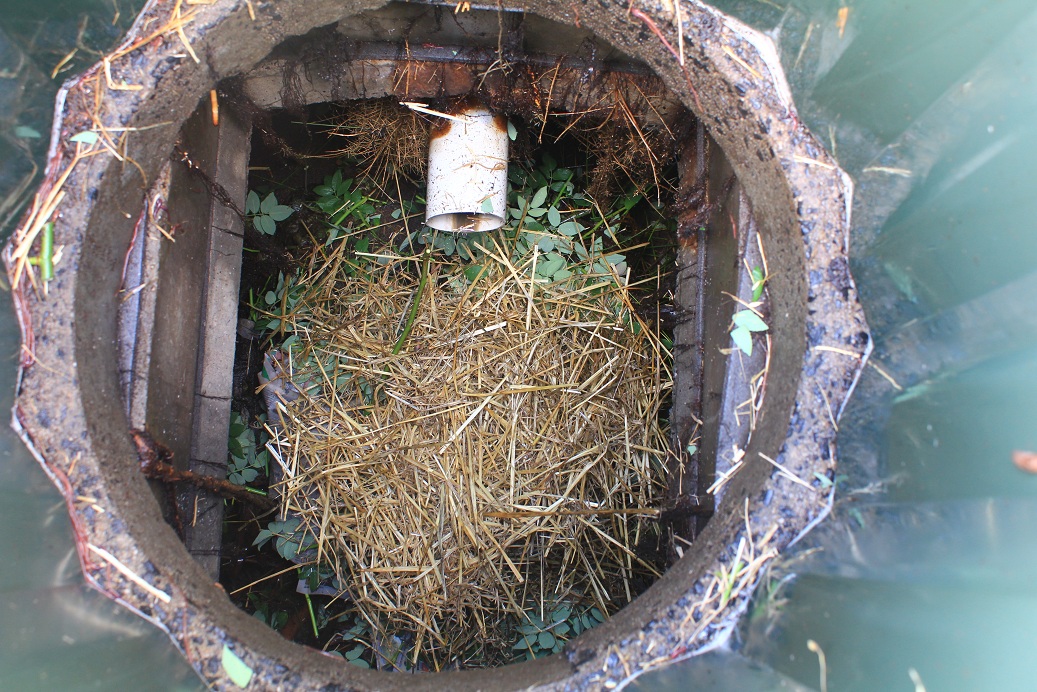
Looks like a compost heap inside!
 
How has it performed?
Even though we have had occasional issues that need attention, we think its performance over the 12 years has been excellent.  During this period it has largely operated day in and day out without us giving it a second thought.
The issues that have arisen with the system have mostly been of a minor nature and were easily fixed.
  • Stuck floats. A couple of times the floats that turn the system off and on have become stuck. Usually the solution is to give the sump outflow pipe a shake and this frees them up.
  • Build up of sediment. Every year or so we pull the pump out of the sump, wash it down, inspect it and empty any sediment that has built up in the bottom of the sump. The pump is not designed to cope with sediment so this is more of a precautionary measure.
  • Pumps have a limited lifespan. Our issue with the pump was detailed in the last post
  • Blocked Disposal trenches. This took a bit of effort to solve, but was very site specific. During the drought (years of very dry conditions) the ground surrounding our disposal trenches dried out to such an extent, it had set like concrete, and lost the capacity to absorb water. We would have had the same issue with any system of underground distribution of waste water.  In these conditions our soils were just not capable of absorbing the required amounts of waste water quickly enough. We replaced the first few metres of the installed underground distribution channels with Plastic Domed Drain Material which had a much bigger capacity and was capable of holding the waste water long enough for it to be absorbed over a longer period of time.
Domed drainage added to each absorption trench
 
Most of our issues were relatively easy to solve in retrospect. They were also part of the process of learning about how the system works, its limitations and maintenance needs. This last point is part of our basic philosophy – to take responsibility where possible for growing food, generating power, harvesting rain water and disposing of our own waste. Life has become one huge learning experience!


Saturday, February 23, 2013

Fixing our Worm Farm Waste Water Treatment System

At about the worst possible time (between Christmas and New Year) one of our electrical safety switches activated, switching off power in the house. After a few minutes of plugging appliances into various power points, we narrowed the problem down to the circuit that supplies the back half of the house.
Further investigation showed the problem was in the submersible pump that pumped waste water out of our worm farm waste water tank. This system processes all our effluent from the kitchen, bathroom and toilet. The waste water filters through a compost heap, where the solids sit until they decompose and the pump empties excess water that builds up in the sump.
 
There is no odour in the worm farm tank but the waste water entering the sump does have a mild smell. (Mild compared to that in a traditional septic system.) Still there is an odour and it is not the best time to be working with it, in the middle of our hottest summer for many years. This timing was also unfortunate because during this period most plumbers, plumbing suppliers and pump repairers were on their annual holiday. We decided that our only option was to have a go at it ourselves.
 
After checking the power point it was clear that the fault lay in the actual pump. It was time to get our hands dirty and extract the pump. It is fairly heavy at 15kg and a reasonably tight fit with the attached floats, but we managed to disconnect the wiring and piping and haul the unit up to the surface. We worked through many of the obvious possible problems trying it out again and again after each time. We even left it for a few days in the hope that if moisture was causing a short circuit it would dry out and at least work for another week or more. No luck!
 
Then we got on the phone and managed to find a pump repairer who worked from home. He did a few tests and told us that it was indeed faulty and would cost more to repair than buy a new one. The next day we went to Water Pros, an irrigation supplier in Lilydale (by now the holidays had finished). They were very helpful and to our amazement had a new pump for us within 2 days at a better price than I could find on the internet. We highly recommend them for their service and price on irrigation and pump equipment.
Once home we removed the piping, floats and wires from the old pump and transferred these to the new pump. After a few trials and tribulations we turned it on and it worked (no tripping of safety switches) and as the water level rose, it activated the shut off float and turned itself off. We were back to normal at last!
 
Altogether it took over a week to get the system working again. That was a week with minimal showers and working out ways to dispose of kitchen and laundry water onto the lawn (not a bad idea in summer anyway). The main worry was the fact that if water levels built up in the tank, the composting worms that process the waste, would all drown. Therefore emptying the waste water in the sump by hand (using a plastic ice cream tub screwed to the end of a pole) became a daily ritual. It took around 30 minutes to lift out about 200 litres.
The pump has now been working well for around six weeks, so we are hoping it will do so for many more years yet. However, both the pump repairer and the irrigation shop staff said you are lucky to get 5 or 6 six years out of a submersible pump in our situation (the old one was 9 years old). When we get time we will take the old one apart and see if we can repair it and keep it as a spare for emergencies.
 
Over the years we have found that it is possible to give things ago ourselves. As owner builders we frequently come across issues that are beyond our existing knowledge. We are by no means technically minded, but often find that doing some research on the web, asking around for information and taking things step by step helps. The process takes longer, can be a bit frustrating but it saves money and we learn new skills at the same time.


Free Hit Counter